
- Readings a day where there is cell signal
- 12
- Readings a day over satellite
- 4
- Deepest tank or trough it fits
- 15 ft
- Per tank per year, after the first year
- $100
What a stock tank monitor does
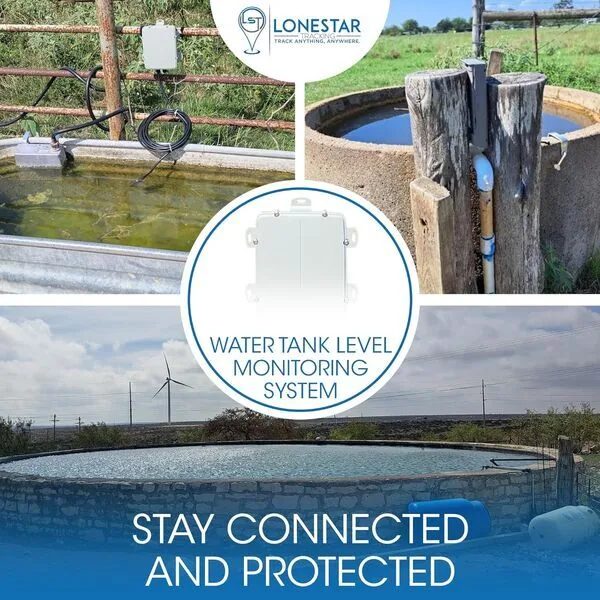
Checking water is one of the most important jobs on any place, and one of the most time-consuming. A stock tank monitor does the checking for you. A sensor in the tank measures how deep the water is, a small radio module sends that reading out, and the level shows up on your phone or computer. When the level drops below a line you set, you get an alert.
It does not replace looking at your cattle. It replaces the drive you make only to find the trough full.
How the water level is measured
The VitaRanch monitor uses a weighted pressure probe that rests on the bottom of the tank. The deeper the water above it, the more pressure it feels, and the sensor turns that pressure into a water level. This is called hydrostatic measurement. There are no floats to stick, foul or freeze, and no moving parts in the water.
- Works in any fresh-water storage tank or trough up to 15 feet deep.
- The cable from the probe to the module is 15 feet. Longer cables are available on request.
- Typical accuracy is within 1% of tank depth.
- The enclosure is rated IP68: dust tight and submersible.
How the reading gets to you
The module holds a cellular radio and a satellite radio. Where there is cell signal at the tank, it reports over cellular every 2 hours, which is 12 readings a day. Where there is not, it reports over satellite every 6 hours, which is 4 readings a day. It picks the network on its own and switches back to cellular when a usable signal returns. There are no buttons to press and no settings to change.
If you want the detail on the two networks, read cellular vs satellite ranch monitoring.
The alerts worth setting
You set three levels for each tank in your VitaRanch account, in feet of water above the probe:
| Level | What it means |
|---|---|
| Warning | Below this level you get a heads-up: check on it. |
| Critical | Below this level, someone needs to go now. |
| High water | Above this level, the tank is about to run over. |
From those you can turn on a low water alert, a high water or overflow alert, and a daily water report that arrives once a day whether anything is wrong or not. You also hear when a tank comes back to normal and when a monitor goes offline. Alerts go out by push notification, text or email, and each person on the account chooses their own.
What the chart tells you
The dashboard draws each tank's level over time with your warning, critical and overflow lines on it, so you see the trend and not only today's number.
- A steady dip during the day that recovers is normal: cattle drinking and the float refilling.
- A sharp drop that keeps going can mean a leak, a broken line, or a float stuck closed.
- A level above your overflow line can mean a float stuck open.
- A slow slide over several days means the supply may not be keeping up.
Installing one
Setup takes a few minutes and a screwdriver. In order:
- Install the two batteries and close the cover with all eight screws, snugged down in a criss-cross pattern. Do this at the shop or the tailgate, not at a windy tank.
- Mount the module on a sturdy post, fence or wall near the tank, with a wide-open view of the sky and the cable entries pointing down.
- Lower the probe slowly until it rests on the bottom of the tank, away from the float valve or fill pipe where incoming water churns.
- Zip-tie the cable at the tank rim so the probe cannot drift or get pulled up, and fasten any loose cable along the post or fence.
- In your VitaRanch account, name the tank and enter its warning, critical and high water levels.
Where not to put the module
The satellite radio needs to see the sky. Do not mount the module under a metal roof, carport or lean-to, inside a metal shed or barn, or under heavy tree cover. Mount it high enough that cattle cannot rub, lick or butt it, and never leave it hanging by the cable.
What it costs
| Item | Cost |
|---|---|
| Monitor, probe and cable | $350.00 per tank |
| Service, first year | Included |
| Service after the first year | $100 per tank per year |
| Shipping | Free |
The monitor ships with two D-size lithium (LTC) batteries (Saft LSH20) that you can replace yourself, with a typical life of about 5 years. Cold winters and sites that report mostly over satellite run shorter. Standard alkaline D cells also work once two jumpers on the circuit board are changed (contact support first), and last about 1 to 2 years. It carries a 1-year limited warranty, and water tank monitors can be returned for a refund or exchanged within 30 days of delivery.
Against the cost of driving
The other side of the sum is the trip. A tank that takes 15 minutes and 5 miles to check, checked every day, adds up to 91 hours and 1,820 miles a year. The Savings Calculator does that arithmetic for your number of tanks, your distances and your fuel price.
What it will not do
- It measures water level, not water quality.
- It reports and alerts. It does not shut a valve or start a pump.
- On satellite it reports 4 times a day, so a tank past cell coverage updates less often than one near town.
- It is built for fresh-water tanks and troughs up to 15 feet deep.
Four readings a day is plenty to catch a tank that is dropping. If your tanks sit where there is cell signal, you get twelve.
Satellite Water Tank Monitor
Cellular and satellite in one unit. $350.00, first year of service included.