
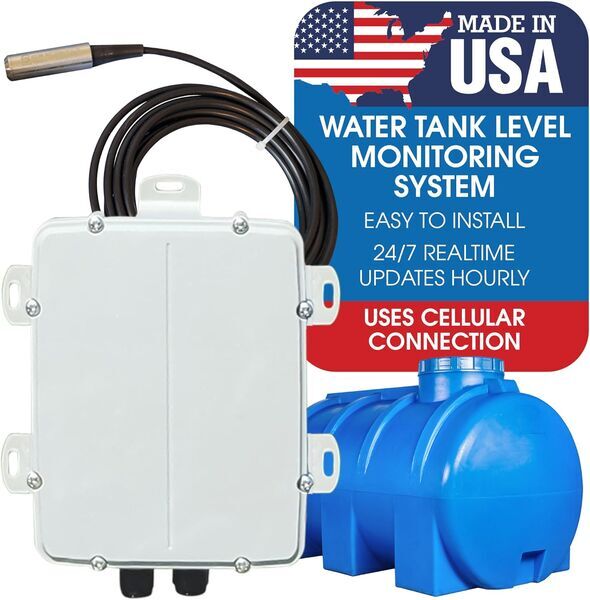
Satellite Water Tank Monitor
Remote water tank & trough monitoring—anywhere the sky is visible. Myriota LEO satellite, 4×AA batteries, 4+ readings/day (timing varies with satellite passes).
Works Where Phones Don't
Direct-to-satellite communication. No towers. No gateways. No infrastructure. If you can see the sky, you're connected—anywhere in North America and beyond.
No Towers, No Gateways
Direct LEO satellite
Multi-Year Battery
4×AA batteries included
Install in Minutes
Drop sensor, mount, pair
Key Features
- LEO satellite network for true global coverage
- 4 measurements per day (every 6 hours)
- Works anywhere in North America with clear sky view
- No cellular towers or WiFi required
- 2-4 year battery life on 4 AA cells
- IP68 rated submersible sensor probe
- No moving parts - nothing to break
- Smart low-level alerts
- Mobile app for iOS & Android
- Web dashboard with historical data
- 15-foot sensor cable included
- Works in the most remote locations
Product Overview
Monitor water levels in the most remote locations where cellular coverage doesn't exist. The LST Vita Satellite Tank Level Monitor uses direct-to-satellite LEO networks—no towers, no gateways, no infrastructure required. Just clear sky visibility. This purpose-built ranch monitoring system provides 4+ measurements per day (typically 5-8 in practice, timing varies based on satellite passes overhead) directly to your phone or computer through our mobile app (available for Android and iPhone) or web dashboard. The system uses a reliable submersible sensor with no moving parts—nothing to break or wear out. Simply drop the sensor into your tank or trough, mount the satellite module where it can see sky, and pair in the app. Done in minutes. Receive smart alerts when water levels fall below your predefined thresholds. The system operates on 4 AA batteries for multiple years thanks to our ultra-efficient satellite communication that draws only microamps of power. Perfect for remote paddocks, wilderness operations, and locations beyond cellular reach.
Why Choose This System?
Save Time & Money
Eliminate daily manual water checks. Monitor all your tanks remotely from your phone or computer, saving hours of labor and fuel costs every week.
Prevent Livestock Loss
Receive instant alerts when water levels drop critically low. Never worry about your animals going without water due to equipment failures or unexpected consumption.
Smart Water Management
Track consumption patterns and predict refill schedules. Historical data helps you optimize water delivery routes and identify potential leaks or equipment issues early.
Built for Ranch Life
Ultra-reliable design with no moving parts, extreme weather resistance, and exceptional battery life. Designed specifically for the demanding conditions of livestock operations.
When Satellite is the Right Choice
Perfect for locations beyond cellular coverage where reliable monitoring is still critical
| Feature | LoneStar Satellite | LoneStar Cellular | WiFi Monitors |
|---|---|---|---|
| Coverage Area | Anywhere in North America | Where cellular exists | WiFi range only |
| Update Frequency | 4 readings/day | 24 readings/day | 4-12 readings/day |
| Connectivity | LEO Satellite | 4G Cat-M1 | WiFi required |
| Installation | Clear sky view required | No special requirements | WiFi network needed |
| Battery Life | Up to 4 years | 3-6 years | 6-18 months |
| Ruggedness | IP68 submersible | IP68 submersible | IP65 splash-proof |
| Remote Locations | Ideal (no infrastructure) | Good (needs cell signal) | Poor (needs WiFi) |
| Annual Service | $100/year | $100/year | Hardware only |
Best For:
- Remote pastures with no cellular coverage
- Off-grid ranches and wilderness operations
- Locations where running cellular repeaters isn't practical
- When 4 readings/day provides sufficient monitoring cadence
Powered by LEO Satellite Constellation
Proven satellite network used worldwide in mining, agriculture, and remote IoT monitoring. Ongoing constellation expansion increases satellite passes and coverage resilience — a mature LEO platform with years of operational history.
Future-proof your investment: As satellites are added, your existing hardware benefits from improved coverage and faster transmission windows automatically.
How It Works
Quick 20-Minute Installation
Drop the sensor probe into your tank, mount the weatherproof module on the tank exterior or nearby post, and configure the device in our mobile app. No wiring, no plumbing modifications, no technical expertise required.
The 15-foot cable gives you flexibility to position the module for optimal cellular signal while keeping the sensor submerged in the water.
Continuous Automated Monitoring
The sensor automatically measures water levels every hour and transmits data via 4G LTE Cat-M1 cellular network. Your tanks are monitored 24/7 with 24 precise measurements per day—even in remote areas with challenging coverage.
Cat-M1 technology provides superior signal penetration compared to standard cellular, ensuring reliable operation in remote ranch locations.
Access from Anywhere
View current water levels, historical trends, and consumption analytics from your smartphone or computer. Our professional dashboard is available on Android, iPhone, and web browsers with real-time synchronization across all devices.
Check multiple tanks at a glance, compare consumption patterns, and export data for record-keeping.
Intelligent Alerts
Set custom alert thresholds for each tank based on your operation's needs. Receive instant notifications via push notification, SMS, or email when levels drop below your specified limits or when unusual consumption patterns are detected.
Configure different thresholds for different tanks, set quiet hours, and manage multiple alert recipients.
Why Choose Satellite Over Generic Solutions
Purpose-built for ranch water monitoring where cellular and WiFi fail
Direct-to-Satellite
No towers. No gateways. No infrastructure. Our LEO satellite constellation delivers connectivity where cellular simply doesn't exist — remote paddocks, wilderness areas, deep valleys, federal grazing land. If you can see the sky, you're connected across all of North America and worldwide coverage available.
Ranch Water & Livestock Focus
Not a generic liquid monitor or alarm box. Built specifically for livestock water management— ranch language, trough-specific features, drought management tools. Unlike industrial SCADA systems or multi-purpose "liquid level\" platforms that spread focus across dozens of applications.
4+ Updates/Day—Stated Clearly
Complete transparency builds trust. Target 4+ readings per day (typically 5-8 in practice) when satellites pass overhead—timing varies, not on fixed intervals. No vague "periodic updates\" or buried fine print. This frequency catches problems early while delivering multi-year battery life—optimal for remote livestock operations where multiple daily checks are sufficient.
Multi-Year on 4×AA Batteries
Set it and forget it. Ultra-low-power satellite protocol delivers 2-4 years of operation on standard AA batteries with 4+ daily transmissions (actual life varies with temperature and sky-view conditions). No solar panels to clean, no frequent battery swaps—minimal ranch maintenance.
No Installer Required
Faster deployment than industrial alternatives. Drop sensor in tank, mount enclosure with sky view, pair in mobile app—done. No specialized tools, no technician callout, no programming. Compare that with SCADA-leaning systems that require configuration expertise.
LEO Constellation Growth
Future-proof investment. Ongoing constellation expansion increases satellite passes and coverage resilience. Backed by proven LEO technology used in mining, agriculture, and remote monitoring worldwide.
🎯 Perfect For These Ranch Scenarios:
- Remote paddocks beyond cellular reach
- Wilderness troughs 10+ miles from roads
- Federal/BLM grazing land with no service
- Canyon/valley locations with signal blockage
- Eliminating weekly 50+ mile drive-arounds
- Preventing dry-trough livestock welfare issues
Remote Ranch Success Stories
Real feedback from operations in the most remote locations
"Our high country pastures are 40 miles from the nearest cell tower. The satellite monitors work flawlessly where nothing else could. Setup was straightforward—mount the module where it can see sky, and you're done. Four updates a day is perfect for our needs."
— Tom Branson
Branson Mountain Ranch, Idaho
"We run cattle across federal grazing land in Nevada—completely off-grid. Tried cellular, no signal. WiFi obviously wasn't an option. These satellite units solved our monitoring problem. Battery life is impressive, going strong after 3 years on the original batteries."
— Linda Vasquez
Desert Sky Cattle, Nevada
"Remote wilderness troughs 15 miles from any road. The satellite system gives us peace of mind without expensive infrastructure. Gets alerts on my phone when we're in town for supplies. Worth every penny for truly remote operations."
— Robert MacLeod
MacLeod Wilderness Ranch, Alaska
"Canyon country with zero cell service. These work where cellular repeaters would cost tens of thousands. Four readings daily catches problems before they become emergencies. Installation took 30 minutes per tank. Brilliant solution for backcountry."
— Marcus Thompson
Red Rock Livestock, Utah
Satellite Installation Process
Simple setup for remote locations—complete in 30 minutes
1. Unbox & Prep
Remove sensor probe, satellite module, 15ft cable, and mounting hardware. Insert 4 AA batteries.
2. Deploy Sensor
Drop sensor probe into tank using the 15ft cable. Secure cable to prevent movement. No drilling required.
3. Mount & Configure
Mount satellite module with clear sky view. Scan QR code with app, set tank name & alerts. Done!
Critical Installation Tips for Satellite:
- Sky view is essential: Satellite module MUST have unobstructed view of the sky. No trees, buildings, or overhangs blocking satellites
- Module positioning: Mount vertically on tank exterior or nearby post. Use full 15ft cable if needed to reach clear sky view location
- Sensor depth: The sensor must be at the bottom of your tank for accurate readings
- First transmission: Initial satellite connection can take 1-4 hours. Be patient—subsequent readings will be every 6 hours
Common Questions About Satellite Monitoring
How does satellite connectivity differ from cellular?
Satellite uses a LEO (Low Earth Orbit) constellation to communicate with your sensor from anywhere with a clear view of the sky. Unlike cellular which requires tower infrastructure, satellite works in the most remote locations. The trade-off is update frequency: target 4+ readings per day (typically 5-8) at variable times versus 24 precise hourly readings for cellular, but battery life is still excellent at up to 4 years on 4 AA batteries.
What does "clear view of the sky" mean exactly?
The satellite module needs a full 360-degree clear view of the sky—no tree canopy, buildings, overhangs, or other structures blocking in any direction. These are LEO (Low Earth Orbit) satellites that are constantly moving across the sky, and at your 6-hour reporting interval a satellite could be anywhere along the horizon. Mounting the module to the side of a tank or post can block half the sky, causing missed readings if a satellite passes behind the obstruction. Mount the module on top of a post or T-post above the tank so nothing obstructs the view in any direction. Inside a barn or under heavy tree cover won't work at all.
How often does the satellite version send readings?
Target: 4+ readings per day on average—typically 5-8 in practice. Unlike cellular (which sends at precise hourly intervals), satellite readings occur when LEO satellites pass overhead. Timing varies based on satellite visibility—not on a fixed schedule. This variable timing is the trade-off for true "anywhere\" coverage without towers or infrastructure. Most ranchers find this frequency catches problems (equipment failures, leaks, abnormal consumption) well before they become critical. If you need predictable hourly updates and have cellular coverage, consider our cellular model instead.
What if there's cloud cover or trees blocking satellite view?
Cloud cover is not a problem—satellite signals penetrate clouds without issue. However,physical obstructions like tree canopy, buildings, or overhangs will block transmissions. The module needs a clear upward view of the sky. Best practice: mount on the exterior side of the tank or on a nearby post in an open area. The 15-foot cable gives you flexibility to find optimal sky-view positioning while keeping the sensor submerged in your tank.
How long do the batteries really last?
Realistic expectation: 2-4 years on 4×AA batteries with 4+ daily transmissions. Actual life depends on environmental factors: cold temperatures reduce battery capacity (expect shorter life in harsh winters), while poor sky-view causes more transmission retries (draining power faster). Optimal placement with clear sky visibility in moderate climates achieves the 4-year mark. The ultra-low-power protocol is key—this is years longer than typical IoT devices.
What's the subscription cost? Total cost of ownership?
The $350 hardware purchase is for the sensor only — no service is included. After purchasing, you'll need to return to our site to activate your device and pay the $100/year service fee which covers satellite airtime, cloud hosting, mobile apps, software updates, alerts, and technical support. Total 5-year cost: $850 ($350 hardware + $500 for 5 years of service). Compare that to the cost of weekly 50+ mile drive-arounds: fuel, time, vehicle wear. Most ranchers break even in the first season and save thousands over five years.
How reliable is the satellite network?
Our satellite constellation consists of LEO satellites specifically designed for IoT applications. The network provides excellent reliability across North America with redundancy built in. Multiple satellite passes per day ensure your data gets through. It's proven technology used in mining, agriculture, and remote monitoring worldwide.
Can I expand coverage globally or just North America?
Our satellite network covers the entire globe. While we specify North America for our standard service, global coverage is available. Contact us if you need monitoring in other regions—South America, Australia, Europe, etc. The hardware is the same; it's just a service configuration change.
Why choose satellite over cellular?
Choose satellite when cellular coverage doesn't exist at your location. If you have reliable cell signal, our cellular model offers more frequent updates (24/day) and slightly longer battery life (3-6 years). But if you're truly off-grid—wilderness, deep valleys, federal land—satellite is your only reliable option for remote monitoring.
Transparent Pricing
We believe in upfront, honest pricing with no hidden fees or surprises. Here's exactly what you get:
Hardware Purchase
One-time cost per sensor unit
- Complete LST Vita Satellite sensor system
- 4 AA batteries included
- 15-foot sensor cable & mounting hardware
- Satellite communication module
- 1-year manufacturer warranty
Note: Service is not included with hardware purchase. After buying, return to our site to activate your device and subscribe to the annual service plan.
Annual Service
Per sensor
- LEO satellite airtime (unlimited)
- Cloud hosting & data storage
- Mobile apps (iOS & Android)
- Web dashboard access
- Software updates & new features
- Email, SMS & push notifications
- Technical support
Total Cost of Ownership: For a 5-year period, you'd pay the hardware cost ($350) plus 5 years of service ($500) = $850 total for 5 years of reliable satellite monitoring in locations where cellular doesn't exist. Compare that to weekly 50+ mile drive-arounds — most ranchers break even in the first season and save thousands in fuel, time, and vehicle wear.
Volume discounts available for operations with 10+ tanks. Contact sales for enterprise pricing.
Technical Specifications
- power
- 4 AA batteries (included)
- warranty
- 1 year manufacturer warranty
- max depth
- Up to 15 feet submersible
- water type
- Fresh water (livestock applications)
- sensor type
- Non-mechanical submersible probe (no moving parts)
- battery life
- Multi-year (2-4 years typical, varies with temperature and sky-view conditions)
- cable length
- 15 feet (4.5 meters)
- connectivity
- LEO Satellite Network (direct-to-satellite, no gateways)
- coverage area
- Global (North America standard, worldwide available)
- operating temp
- -30°C to 70°C (-22°F to 158°F)
- compatible tanks
- All standard water tanks and livestock troughs
- enclosure rating
- IP68 (submersible & dust-tight)
- update frequency
- 4+ readings per day (typically 5-8, timing varies with satellite passes)
- installation time
- Minutes—no installer required
- power consumption
- Ultra-low microamps (satellite optimized)
- sky view required
- Clear view of sky required for satellite communication
- annual subscription
- $100/year after first year
- measurement accuracy
- ±1%